Thursday, October 17, 2013

First frost, lots of squash, last tomatoes, and nasturtiums take over!

According to local lore (and the nearby Taunton averages as recorded by UMass) my first frost happens on October 15th or thereabouts.  My first frost of 2013 was overnight between the 13th and 14th --very close to average, despite all the weather changes of the last few years.
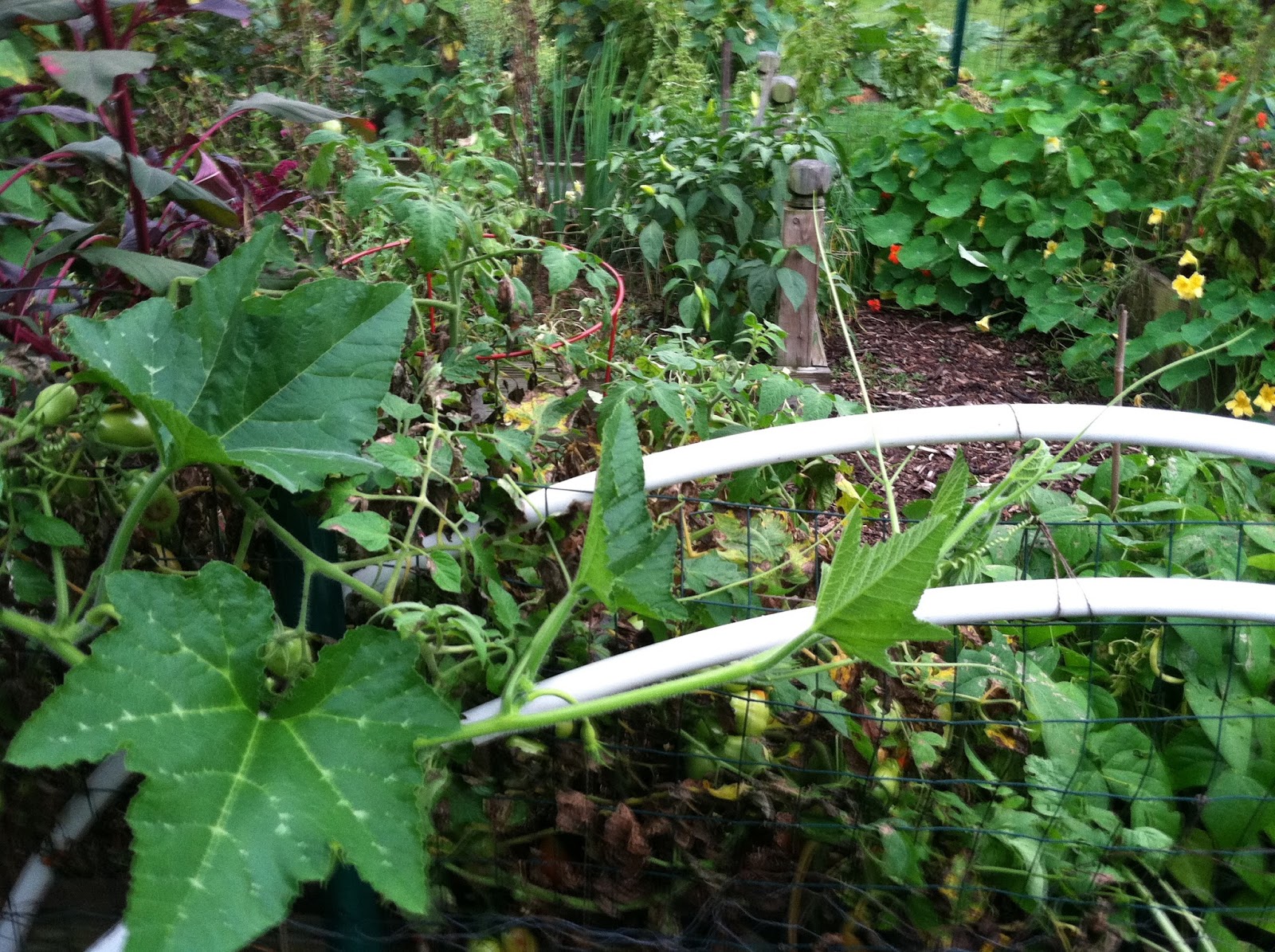
It was a mild frost, and only nipped the lushest leaves of my trombone squash:


Meanwhile the production of more squash continued unabated:


I've had several 'free squash' days at work, and the half dozen curved fruit I brought each time have gone fast.  At home we are all sick of squash.  Well, that's not true-- Sol (my dog)  still eagerly eats it steamed al dente.

Unlike squash, every tomato is loved around here, and today we had a moment of silence when I ate the last one. Here's a pic of the last bowl of tomatoes -- my husband Tom wanted me to have them all, but I wouldn't let him, so we split them and each savored every bite. I wanted to start singing Guy Clark's 'Home Grown Tomatoes', but I can't carry a tune, so I didn't.


I have been astonished with the Nasturtiums in the kitchen garden this year.  My  Nasturtiums  are usually either all leaves because they got too much fertilizer or scraggly and full of flowers because they got too little.
This fall they are all lush and green (except for variegated 'Alaska') and full of flowers. As I have harvested the beds I've let the nasturtiums sprawl across the the garden, much to the delight of my faithful bumblebees and some actual honeybees that have appeared in the last couple of weeks.  I am so happy to see the honeybees that I talk to them like old friends, saying 'hi sweety, enjoy those flowers' and so on.
Here's some self seeded 'Alaska', spreading out in the former Butternut squash bed:


Here's a mix of self seeded hybrids and some 'Jewel' I planted this year, along with reseeded Nicotiana:


And the frost didn't reach my 'Heavenly Blue' morning glories, which are cascading over the fence behind my asparagus bed:


Saturday, October 5, 2013

Fall harvest continues-- tomatoes and squash

I let one of my trombone squash mature, in hopes of checking out how it tastes as winter squash and collecting seed-- here's a pic with Sol for size comparison:


And I have pulled all my tomato plants, but lots of fruit are still maturing in the garage:


There are a few peppers in the middle basket-- I may get enough Hungarian hot wax peppers for a few more jars of refrigerator pickles.
Meanwhile, the planning for next year begins.....

Friday, September 27, 2013

A season of flower bouquets

Before I was a kitchen gardener I was a flower grower, and the many beds of tough perennial flowers that still fill my yard supply me with vases full of color and scent from April until frost.
They are not 'arrangements' -- I rarely spend more than 30 seconds stuffing them into water on the dining room table, but they do remind me that gardens feel the soul as well as the stomach.

Heres a selection, in seasonal order:


This  next one is special - it is from this week, and these are the flowers of my delicious Sunchokes!
Vegetable and flower garden combined in one plant.


And there are more to come-- In October there are Asters and single chrysanthemums. I hope I'm not too busy to pick a bunch and take the time to sit and enjoy them.

Saturday, September 14, 2013

Late summer -- tomatoes and amaranth and sunchokes

Well, the moisture and the heat finally did it-- my tomatoes have blight. So I've harvested anything with a hint of color and moved them into the garage and dining room to ripen.
 I pick them over everyday and cut up and freeze the good parts of any showing sign of blight, and eat the rest fresh. There are at least a hundred tomatoes between the two locations, and I picked more today, along with a few peppers, an eggplant, and several squash:


That's a barrel of late bib lettuce in the background.
The blighted tomatoes are a sad sight, though I have noticed most other gardens in my neighborhood were blighted weeks ago-- I hope that means my early measures to reduce spread (picking off lower leaves and mulching with grass cuttings) helped slow the arrival and spread in my garden.


Meanwhile, the older, root end of the trombone squash is dying off:


But the leading edge, 20 feet ahead, is lush and still going:


And some plants are just peaking, including the amaranth (which I grow mostly for it's beauty-- the leaves are only tasty when young, and I'm not interested in all the work and little return from harvesting the grain).  I love how the flowers turn upwards towards the sun when the stalk falls over under it's own weight.


And the sunchokes (Jerusalem artichokes) are just beginning to form flowers-- they will bloom in a couple of weeks, about the same time as my late chrysanthemums.  Here they are reaching for the clouds (12 feet hight!) in the late evening light of my mid September garden:


Thursday, August 29, 2013

Spotlight on: Scarlet Emperor Runner Bean

I have grown runner beans in my kitchen garden several times over the last ten years. Each time I enjoyed the flowers, but was disappointed by the low production of beans-- the few I got were wonderful, with a deep rich flavor, but production was sparse compared to pole beans such as Rattlesnake.
This winter the catalog description of Scarlet Emperor convinced me to include runner beans in my garden again. Well, despite a rainy spring the seeds sprouted well. During the heat wave last month there were more flowers than beans (heat can reduce bean set in runner beans), but now that nights are cool and days are warm the Scarlet Emperor is the ruler of my August garden, producing lots of deep green, rich flavored beans that are still tender even when eight inches long.  And the flowers! Every time I'm in the garden the resident female hummingbird buzzes by, protecting her beloved red runner bean blooms from all comers.

Here's the trellis full to overflowing this week:


And a  closer view of the many young beans and flowers:

And a stem of  buds and blooms -by far the showiest runner bean flowers I've grown:


Besides the runner beans, romano pole beans, trombone squash, raspberries, Hungarian wax peppers, and finally, tomatoes are yielding well. Here's a picture of today's harvest:


And lots more tomatoes coming -- I have 24 plants left after the early demise of the potato leafed heirloom.  Which, by the way, ended up producing a dozen fruit, since all the fruit  I harvested green when I pulled the plant ended up ripened on the kitchen counter to red juicy deliciousness. I still prefer my Mortgage Lifters --- I have a dozen healthy specimens full to falling over with fruit.

Wednesday, August 21, 2013

Hunting the tomato hornworm

Last week I noticed something new about a clump of intertwined Celebrity and Mortgage Lifter tomatoes in a planter -- leaves were disappearing.  When I looked closely I realized that it had been going on for some time, but the overall lushness of the two plants had hidden the loss until it was substantial.

Here's a picture of the plants.  As usual I did not offer them enough support, and the strategically placed garden chair is helping them stay up right under the weight of a hefty load of young tomatoes.


Here's a close up of a well trimmed branch, with all the soft tasty foliage eaten:


And horror of horrors, a half eaten green tomato:


After I examined the damage I knew the culprit, because I had seen it before -- a tomato hornworm.  A week before this discovery I removed and killed one on a hungarian wax pepper plant. Unfortunately I killed the hornworm after it had eaten a substantial portion of the plant, but I have hope that there is still  time for regrowth and new peppers.
I also recently found a  rather deflated hornworm covered with the spiky white eggs of a predatory wasp, which I left to die slowly in place (they stop eating when they start getting eaten). It's  a gruesome fate that I have no sadness about after observing the damage done by  hornworms left unchecked.

But I could not find the hornworm on the intertwined plants. For three days I searched, looking for the characteristic drops of black worm poop, and gently pushing eaten leaves aside to search for the elusive pest. It was obviously healthy and not wasp infected, based on the newly denuded leaves I found each day.

Finally yesterday I found it! A drop of poop on a leaf, and just above, fat and munching slowly, my enemy. I read an essay in my local paper by a squeamish gardener who put a live horn worm, attached to a small branch, in a sealed baggie and into the trash to suffocate. That seems crueler and less green than my solution-- position it under a brick and step on the brick. Here's a portrait of my enemy shortly before it's demise: