Thursday, December 26, 2013

Greens in the winter (not the kind you eat!)

While it's true I now garden primarily for food, I also think about other needs when I plant.
And one of them is my need for green in the garden in the winter. And no, that doesn't mean 'greens' grown under plastic, like my neighbors down the street at the little garden that could.

As I have said before, I don't grow winter crops-- I'm just too busy at work, and I'd rather not do something than do it with less than all my attention.

But I have planted evergreens around my one acre lot in strategic places for viewing, and I do make a wreath or swags from these trees and shrubs every December. It's amazing how a bit of green accented with red berries can cheer me up on a dreary day.

My favorite evergreen is the male Ilex opaca ( a holly native to much of the East Coast) which I planted as a rooted cutting from Appalachian Nursery in 1994.  It's now twenty feet tall, and gorgeous:


But since it's a male, it doesn't have berries.  Luckily, my one male holly can pollinate many closely related species, including the native Ilex verticillata, which drops it's leaves but sets lots of bright red berries:


The big holly also pollinates some hybrid English hollies along the eastern edge of the garden, and their shiny leaves make a nice contract with the matte leaves of the opaca in an arrangement:


The other day I took cuttings from all my hollies, including the small leaved glabra,


as well as branches from arborvitae, juniper and bittersweet (yes, I work hard to kill all the bittersweet, but some survives, and it is pretty):


I tied them all together with wire into two swags, then hung one from the pillar on my front porch:


The second swag adorns my beloved dry stone wall, a relic of the farm that was here long before my house:


It's amazing how these two simple arrangements of red and green cheer me up when I see them every night as I roll my truck down the driveway at dusk.

Thursday, November 28, 2013

Thanksgiving asparagus bed clean up

It's thanksgiving today, and I'm grateful for the asparagus bed that will finally be 3 years old this spring, which means I can pick the new spears for about four weeks without weakening the plants.
This asparagus bed is the cornerstone of my plan for a more perennial food garden, and I've nursed the plants along from  mail order crowns through cold, rain, drought and asparagus beetles into an abundant and healthy patch of tall, ferny foliage. Yes, it's very ornamental-- but I'm ready to start eating rather than looking at my asparagus.
There were a lot of little bright red asparagus beetles this summer. I killed as many as I could, and became quite adept at capturing the sneaky little creatures. I discovered that they tend to avoid predators by dropping straight down when disturbed, and used this knowledge against them by positioning one hand under the bug and then waving the other nearby. Sure enough, most beetles dropped right into the waiting trap-hand, and were quickly squished.
But I'm sure some beetles laid eggs or pupated in the asparagus foliage, so today I cut it back and trucked it across the yard to my most distant compost pile, then packed dogwood leaves around the asparagus crowns to keep them cosy for the winter. In the late winter I'll add some lime (my soil is a bit acid for asparagus) and compost to give the asparagus a good start. Here are some pictures of the clean up, with Sol supervising.


Sol thinks the leaves are for him to sleep in, not for the asparagus.

Happy Thanksgiving.

Friday, November 8, 2013

2013 Sunchoke (Jerusalem Artichoke) harvest begins

I met a college student last week who volunteers at an inner city community garden, who asked me what  I thought were the most disease free, productive crops I've grown. The answer was easy --trombone squash and sunchokes!
Unfortunately, neither is ideal for a community garden plot -- the trombone squash needs lots of square footage to romp along productively (though it adapts well to being tied to a fence), and sunchokes need careful harvesting to be part of a crop rotation-- they are so vigorous that a tiny piece left behind will overwhelm the intended crop if not meticulously weeded.
But both crops are productive, nutritious, trouble free and mild flavored vegetables that adapt to a wide range of cuisines.
I did a few things different with sunchokes this year. Like my other perennial crops, they  now have their own dedicated bed, and will not rotate out of it unless there is an unexpected pest or disease problem. Because of the 10-12 foot height of the mature sunflowers, this bed is at the back of the garden, where it won't shade other crops.
I am also not going to dig up several bushels of sunchokes at a time, because they don't store well out of the ground. I will use thaws throughout the winter to harvest a few pounds at a time, using the bed as my root cellar.
And to avoid digestive problems I did not start digging the sunchokes until several hard frosts, so that they could change chemically into a more digestible starch.
The flowers were a great treat in October-- so fresh and bright:


We had several hard frosts in late October, and earlier this week I decided to cut back the tops and dig a few tubers. I used my loppers to snap the thick stems, then laid the frosted tops next to the bed:


Last fall the tubers were big, many larger than my fist. Would the harvest be as good this year, or had I planted them too thickly, or not watered enough during the October drought?
Finally the moment of truth-- I grabbed the bottom of a clump of trimmed stems and pulled.  And pulled-- finally I had to brace myself with both feet and use two hands.


I needn't have worried-- I pulled about five pounds off that one clump! I rinsed them off, them put them in the garage on newspapers to dry. Then I mulched the rest of the planting with leaves from the lawn. That was it-- my sunchoke bed is ready for harvest through the winter.
I  ate my newly harvested tubers for the first time tonight, prepared very simply.  I scrubbed them and cut off any brown spots, then parboiled them several minutes,  then caramelized them under the broiler with olive oil, rosemary, salt and pepper. Crunchy on the outside, soft in the middle, all delicious.


Thursday, October 17, 2013

First frost, lots of squash, last tomatoes, and nasturtiums take over!

According to local lore (and the nearby Taunton averages as recorded by UMass) my first frost happens on October 15th or thereabouts.  My first frost of 2013 was overnight between the 13th and 14th --very close to average, despite all the weather changes of the last few years.
It was a mild frost, and only nipped the lushest leaves of my trombone squash:


Meanwhile the production of more squash continued unabated:


I've had several 'free squash' days at work, and the half dozen curved fruit I brought each time have gone fast.  At home we are all sick of squash.  Well, that's not true-- Sol (my dog)  still eagerly eats it steamed al dente.

Unlike squash, every tomato is loved around here, and today we had a moment of silence when I ate the last one. Here's a pic of the last bowl of tomatoes -- my husband Tom wanted me to have them all, but I wouldn't let him, so we split them and each savored every bite. I wanted to start singing Guy Clark's 'Home Grown Tomatoes', but I can't carry a tune, so I didn't.


I have been astonished with the Nasturtiums in the kitchen garden this year.  My  Nasturtiums  are usually either all leaves because they got too much fertilizer or scraggly and full of flowers because they got too little.
This fall they are all lush and green (except for variegated 'Alaska') and full of flowers. As I have harvested the beds I've let the nasturtiums sprawl across the the garden, much to the delight of my faithful bumblebees and some actual honeybees that have appeared in the last couple of weeks.  I am so happy to see the honeybees that I talk to them like old friends, saying 'hi sweety, enjoy those flowers' and so on.
Here's some self seeded 'Alaska', spreading out in the former Butternut squash bed:


Here's a mix of self seeded hybrids and some 'Jewel' I planted this year, along with reseeded Nicotiana:


And the frost didn't reach my 'Heavenly Blue' morning glories, which are cascading over the fence behind my asparagus bed:


Saturday, October 5, 2013

Fall harvest continues-- tomatoes and squash

I let one of my trombone squash mature, in hopes of checking out how it tastes as winter squash and collecting seed-- here's a pic with Sol for size comparison:


And I have pulled all my tomato plants, but lots of fruit are still maturing in the garage:


There are a few peppers in the middle basket-- I may get enough Hungarian hot wax peppers for a few more jars of refrigerator pickles.
Meanwhile, the planning for next year begins.....

Friday, September 27, 2013

A season of flower bouquets

Before I was a kitchen gardener I was a flower grower, and the many beds of tough perennial flowers that still fill my yard supply me with vases full of color and scent from April until frost.
They are not 'arrangements' -- I rarely spend more than 30 seconds stuffing them into water on the dining room table, but they do remind me that gardens feel the soul as well as the stomach.

Heres a selection, in seasonal order:


This  next one is special - it is from this week, and these are the flowers of my delicious Sunchokes!
Vegetable and flower garden combined in one plant.


And there are more to come-- In October there are Asters and single chrysanthemums. I hope I'm not too busy to pick a bunch and take the time to sit and enjoy them.

Saturday, September 14, 2013

Late summer -- tomatoes and amaranth and sunchokes

Well, the moisture and the heat finally did it-- my tomatoes have blight. So I've harvested anything with a hint of color and moved them into the garage and dining room to ripen.
 I pick them over everyday and cut up and freeze the good parts of any showing sign of blight, and eat the rest fresh. There are at least a hundred tomatoes between the two locations, and I picked more today, along with a few peppers, an eggplant, and several squash:


That's a barrel of late bib lettuce in the background.
The blighted tomatoes are a sad sight, though I have noticed most other gardens in my neighborhood were blighted weeks ago-- I hope that means my early measures to reduce spread (picking off lower leaves and mulching with grass cuttings) helped slow the arrival and spread in my garden.


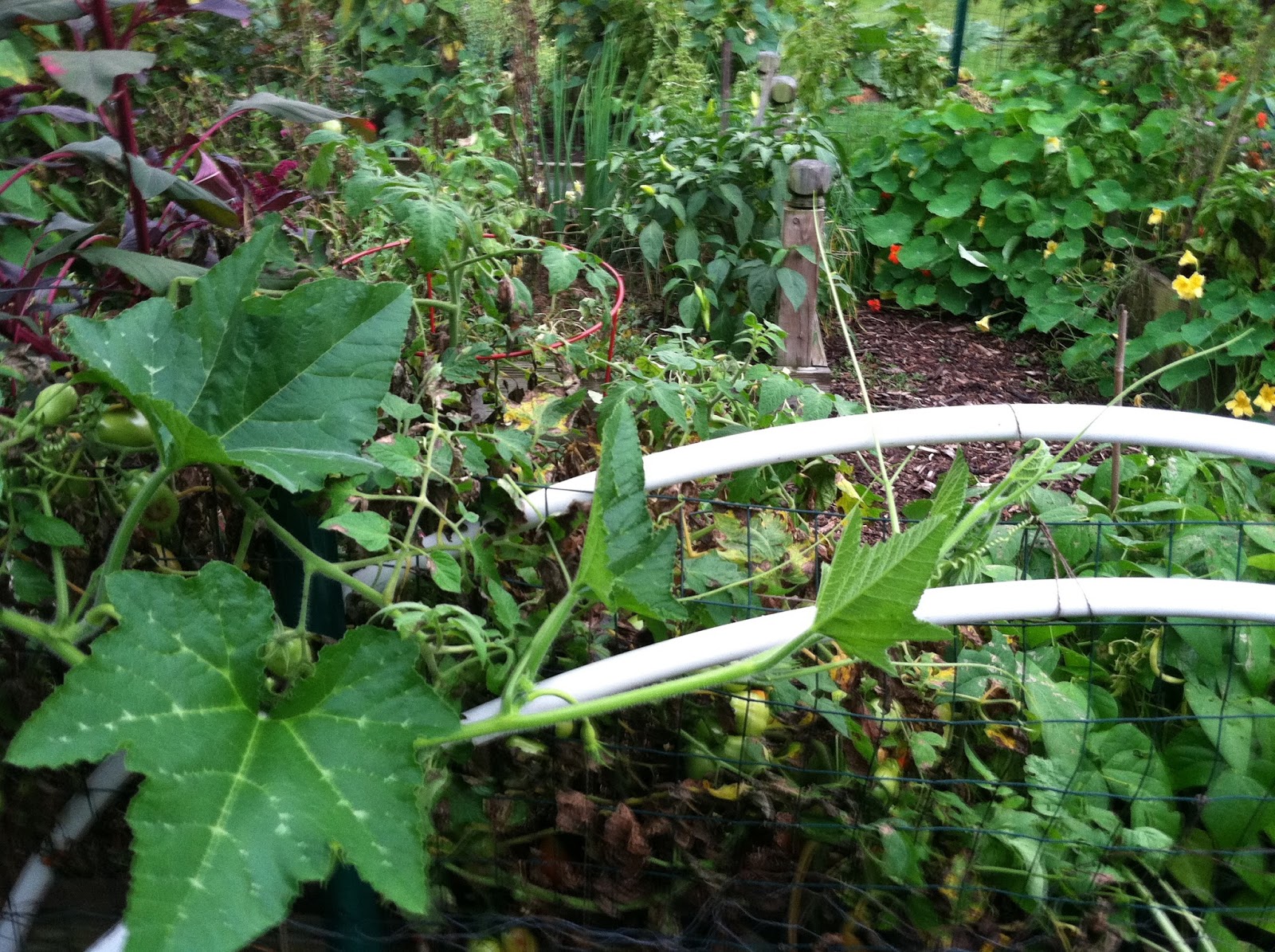
Meanwhile, the older, root end of the trombone squash is dying off:


But the leading edge, 20 feet ahead, is lush and still going:


And some plants are just peaking, including the amaranth (which I grow mostly for it's beauty-- the leaves are only tasty when young, and I'm not interested in all the work and little return from harvesting the grain).  I love how the flowers turn upwards towards the sun when the stalk falls over under it's own weight.


And the sunchokes (Jerusalem artichokes) are just beginning to form flowers-- they will bloom in a couple of weeks, about the same time as my late chrysanthemums.  Here they are reaching for the clouds (12 feet hight!) in the late evening light of my mid September garden: